
Stop trying to turn PoCs into products
Many AI & software initiatives stall because proofs-of-concept, pilots, and production get blurred. This post explains why PoCs must stay disposable, and how pilots and production prove practicality and accountability.

From proof-of-concept to pilot to production: what business leaders need to understand
A non-technical friend messaged me recently: "We got our AI tool working." It had taken a small group a couple of weeks to get a model reliably summarising a folder of documents. The results looked genuinely useful. But what they had built was a proof-of-concept (PoC) - a handful of test files, no access controls, no logging, no plan for what happens when the model gets something wrong. Rolling it out as-is would not be an AI deployment, it would be an incident waiting to be discovered.
This kind of thing happens constantly, and it is rarely about the technology. It is about language. In AI and software delivery, "proof of concept", "pilot", and "production" are often used as if they were interchangeable stages. They are not, and treating them that way just creates governance, risk, and investment issues.
I have written about the pipeline from PoC to production and
Managing your innovation pipeline through AI projects but that chat with a friend made me realise that I had never explained the nuts and bolts of this kind of pipeline. And I suspect that many people may not understand why they might need to understand this. It will probably read as more instructional than my usual posts - but that is the point.
Each stage has a distinct purpose, level of maturity, and risk profile. Understanding these differences is essential if you are funding, approving, or governing AI and software initiatives.
The three stages explained
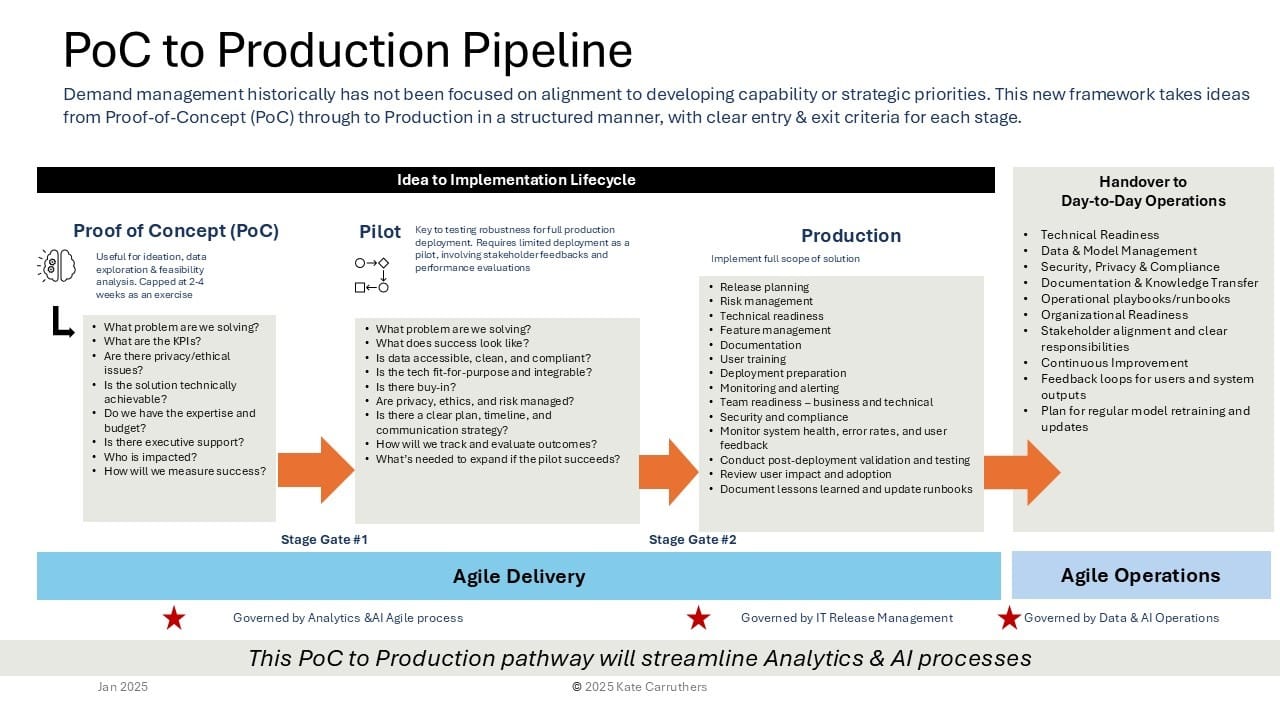
Proof-of-concept: can this work at all?
A proof-of-concept (PoC) is a tightly scoped experiment designed to demonstrate technical feasibility. At this stage:
- The goal is learning, not value delivery
- Data is often sampled, can be synthetic, or loosely governed
- Architecture is deliberately minimal and not designed for scale
- Security, compliance, and integration are intentionally out of scope
In AI, a PoC might test whether a model can summarise documents or classify inputs with acceptable accuracy.
The key governance point: A PoC should always be treated as a throwaway result.
It is not “version one” and should not be hardened into production; instead, it provides useful insights about feasibility, constraints, and potential risks that inform whether a pilot is justified.
It does not answer: Is this safe, usable, or worth operating?
Pilot: does this work in the real world?
A pilot is a limited roll-out of a near-complete system into a real environment, with real users and real data. At this stage:
- A defined user group (often a single team or business unit) is involved
- Live business processes and actual customer or internal data are used
- Integration with existing systems and workflows begins
- Risks start to be actively managed (privacy, security, human oversight)
- Metrics focus on usability, reliability, and business impact
In AI, a pilot might be an internal deployment of an assistant or classifier where outputs are monitored for accuracy, bias, and failure modes, and users provide structured feedback.
Production: can this be trusted at scale?
Production is where the system becomes part of normal operations and is treated as a business-critical capability. At this stage:
- The system is integrated into enterprise architecture and core workflows
- Data pipelines are robust, auditable, and governed
- Security, compliance, and regulatory expectations are met by design
- SLAs, monitoring, and incident response processes are in place
- Ownership and accountability are clearly defined across business and technology
For AI systems, production also involves:
- Ongoing monitoring for model drift and performance degradation
- Defined human-in-the-loop oversight and escalation paths
- Explainability and auditability to support internal and external scrutiny
- Alignment with organisational responsible AI and governance frameworks
Why this distinction matters more in AI
Traditional software has always had a progression from concept to pilot to production, but AI increases the stakes. AI systems are probabilistic, heavily dependent on data quality, and can fail in subtle ways that are hard for non-specialists to detect. This is why we have developed best practices like this from CSIRO: Responsible AI Pattern Catalogue: A Collection of Best Practices for AI Governance and Engineering.
That means:
- The gap between “it works in a demo” and “it is safe to operate” is larger
- Governance requirements around fairness, transparency, and accountability are higher
- Regulatory expectations are evolving, particularly for high-impact uses of AI
Treating a PoC as anything more than disposable in this context is not just optimistic - it risks embedding untested assumptions and hidden vulnerabilities into production environments.
The real gap: from pilot to production
Most organisations can run PoCs and pilots; the real difficulty is moving from pilot to production. That transition typically requires:
- Formal governance and risk frameworks for AI systems
- Clear operational ownership and funding beyond “innovation budgets”
- Integration into existing business processes and controls
- Executive-level risk acceptance and oversight structures
This is also where disconnected experiments either mature into sustainable capabilities or remain isolated demos that never scale. Organisations that treat AI as a chain of unconnected pilots tend to accumulate expensive proofs of concept and shadow systems, rather than reliable business value.
A practical example
Consider AI-assisted document summarisation for a knowledge-intensive team:
- PoC: A small group tests an AI model on a sample of documents to see if summarisation is accurate enough to be useful. They learn about feasible use cases and failure modes and then discard the PoC artefact.
- Pilot: The capability is offered to a specific team, integrated into their workflow, using real documents under controlled conditions, with monitoring and feedback loops.
- Production: The summarisation capability is built into document management systems, with access controls, logging, model monitoring, and clear policy about when human review is required. Governance and support processes are established.
The technology may look similar at each stage; what changes is the level of control, accountability, and trust.
What business leaders should do
To reduce wasted effort and unmanaged risk:
- Be explicit about which stage is being funded - PoC, pilot, or production - and set expectations accordingly.
- Treat PoCs as disposable learning exercises that inform decisions, not as assets to be “polished up” later.
- Recognise that most of the cost and complexity sits in the pilot-to-production transition, not in the initial PoC experiment.
- Require governance and risk considerations to be built in early, so they are not retrofitted under pressure.
- Ask not only whether the system works, but whether it can be operated responsibly at scale.
- PoC proves possibility
- Pilot proves practicality
- Production proves accountability
In the Australian context
This matters more in Australia than the numbers might suggest. Local organisations are under real pressure to move fast on AI, often with boards and executives who read the same headlines everyone else does and want to see progress. That pressure makes it tempting to skip straight from a promising PoC to a public-facing rollout, especially in sectors like health, finance and government where the appetite for demonstrable AI adoption is high but the regulatory and reputational cost of getting it wrong is higher still.
Australia does not yet have the depth of AI-specific case law or regulatory precedent that organisations can lean on when something goes wrong. That makes internal governance discipline - knowing the difference between "it worked in the demo" and "it can be trusted in production" - less a nice-to-have and more the only real safety net available right now. The organisations that get this right will not be the ones that ran the flashiest PoC. They'll be the ones that knew which stage they were actually in.


