
In the history of business, technology has always been the driver of change, from stone tools to the internet. Artificial Intelligence (AI) is simply the most recent, and arguably among the most powerful, addition to this long line of technologies. However, like every revolutionary technology that came before it, its true value isn’t inherent in the tool itself, but in how we choose to wield it. The core imperative for leaders today is to move past the initial fascination and focus on the disciplined work of understanding, governing, and implementing AI safely and effectively within their organisations.
It was a productive week recently, being back at the Australian Graduate School of Management (AGSM) at UNSW Business School in Sydney. I was pleased to be back facilitating my executive short course, AI for Organisational Innovation, along with co-facilitating (with Gladwin Mendez) the last day of the new Building an AI Strategy short course, led by old friend Nicola Dorling.
The level of engagement from the attending leaders was highly focused and constructive. It is reassuring to see executives and senior managers actively dedicating time to understand the profound implications of AI, not just as a peripheral trend, but as a core requirement for contemporary leadership and innovation within their organisations. It is rewarding to engage with such a thoughtful cohort of leaders. Their willingness to tackle these complex, strategic challenges head-on is an encouraging sign for the future of business leadership in Australia.
Getting AI from Proof-of-Concept to Production
In the course, the focus was squarely on the practicalities of deployment and scale, and how to deliver business results using AI. The challenge for many organisations is moving beyond isolated proofs-of-concept and achieving systemic transformation. To address this gap, I presented my framework for moving AI initiatives successfully from proof of concept to robust production environments.
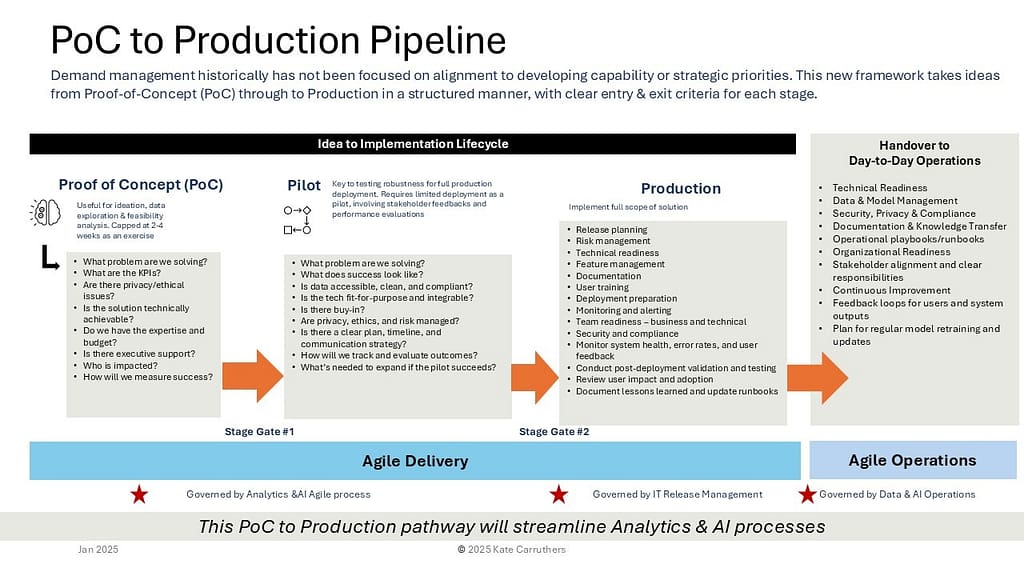
This PoC to Production pipeline is an essential way to think about developing new AI capabilities and getting them from a proof-of-concept through to production.
In thinking about the foundational requirements for successful AI adoption, I always stress the need for AI ethical frameworks, data governance including data quality. As I consistently highlight, trustworthy data is the essential prerequisite for reliable AI systems. Another thing I covered is frameworks for identifying high-impact operational areas and discussed how to securely embed AI models, including emerging agentic AI, to drive both efficiency gains and the creation of entirely new forms of business value. This practice needs to be grounded in moving from theoretical knowledge to actionable, disciplined implementation.
Old tools for the new world
There were some interesting older tools I used during this course. A number of these old tools from business school dated from the 1980s or 1990s such as Christensen‘s jobs to be done, the Hackman Authority Matrix, and the value proposition canvas. These tools still offer great ways of thinking about business problems, even in the age of AI. I am a huge fan of things that you can draw on a whiteboard in a meeting room to facilitate discussion and thinking about key issues that need to be considered. And each of these old tools does just that.
Jobs to be done
This venerable concept is one of my favourites, by Clayton Christensen it helps us to understand what is the job the customer wants help with. An essential thing to understand when embarking on your innovation journey.
Hackman Authority Matrix
This is great tool for thinking about power structures in your organisation. Once you understand these it can really help your innovation journey.
Value Proposition Canvas
I love this simple one page canvas – similar to the business model canvas – as a way of focusing groups in on looking at problems from the customer perspective.
Innovation is not new, we’re just using new tools
Innovation isn’t new; we’ve just swapped out the tools. Humans have always been innovators, from the printing press to the internet. What’s different now isn’t the urge to innovate, but the scale and speed of it. AI, data, and automation are just the latest additions to an ancient habit: solving problems in smarter ways. The real challenge isn’t adopting the shiny new tech, it’s remembering that the tools have changed but the very human fundamentals of curiosity, experimentation, and adaptation haven’t.
Leadership matters
Leadership matters more than ever. AI is a great technology that offers the promise of great things. It also has the same downsides of every other technology – it can be used for evil too. We have agency in how we use this technology. Think about it and think about the risks as well as the benefits of using AI, use the power of AI for good and not evil. And beware of the unintended consequences of using AI.